

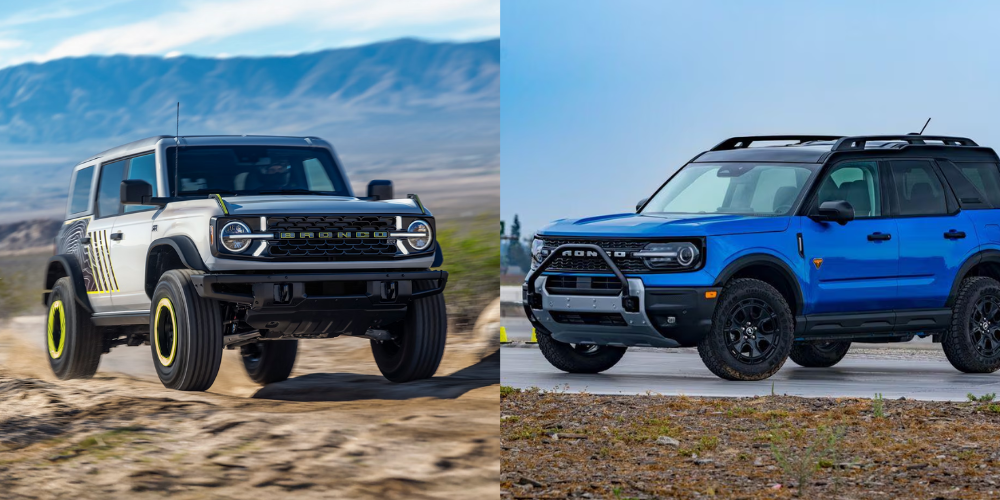
The Ford Bronco and Ford Bronco Sport share a recognizable name, rugged styling, and an adventure-ready attitude. However, they are designed for different types of drivers.
The Bronco is a larger, more specialized off-road SUV built for demanding trails and open-air driving. The Bronco Sport is a compact SUV that combines outdoor capability with the comfort, efficiency, and maneuverability many drivers need during the week.
Choosing between them depends on where you drive, how much space you need, and how serious you are about off-road travel. Comparing their size, capability, comfort, fuel economy, and everyday usability can help you find the better fit.
Ford Bronco vs. Bronco Sport: What Is the Main Difference?
The biggest difference is the way each SUV is built.
The Ford Bronco uses a truck-style, body-on-frame platform designed to handle difficult terrain. It is available in two-door and four-door configurations and offers features such as removable doors, removable roof panels, advanced four-wheel-drive systems, and specialized off-road equipment.
The Bronco Sport is a smaller, car-based compact SUV. It comes with four doors, seating for five, and standard four-wheel drive. While it is more capable away from pavement than many compact crossovers, it is primarily designed to remain comfortable and convenient during everyday driving. Ford equips every current Bronco Sport with four-wheel drive, while its available equipment and drive modes vary by trim.
In simple terms, the Bronco places trail capability first. The Bronco Sport creates a more even balance between outdoor recreation and daily transportation.
Size and Maneuverability
Size is an important consideration, especially for drivers who regularly travel through traffic, use parking garages, or park in crowded shopping areas.
The four-door Bronco is longer and wider than the Bronco Sport. For example, Ford lists the four-door Bronco Big Bend at 189.4 inches long, while the Bronco Sport is approximately 173 inches long, depending on its configuration.
That difference is noticeable from behind the wheel. The Bronco’s larger body gives it a commanding road presence and creates room for passengers, equipment, and available off-road hardware. However, its width and overall footprint may require additional attention in narrow parking spaces or tight urban streets.
The Bronco Sport feels more like a traditional compact SUV. It is easier to place within a lane, maneuver through a parking lot, and fit inside a garage. Drivers moving from a sedan or small crossover may also find the Bronco Sport easier to become comfortable with.
For commuting, errands, and city driving, the Bronco Sport has the advantage. Drivers who prefer a larger vehicle and do not mind its added size may appreciate the Bronco’s substantial feel.
Passenger Room and Cargo Space
Both models seat up to five people, although the Bronco’s passenger capacity depends on the selected two-door or four-door body style.
The four-door Bronco is generally the better Bronco configuration for families because it provides easier rear-seat access and more room for cargo than the two-door model. Its larger exterior dimensions can also be helpful when carrying camping gear, sports equipment, coolers, and other bulky items.
The Bronco Sport uses its compact dimensions efficiently. Its upright roofline helps create useful passenger and cargo space without making the SUV unnecessarily large. The rear seats can be folded when additional cargo room is needed, and available washable or rubberized cargo surfaces can make cleanup easier after hiking, camping, or traveling with pets.
The Bronco offers more of the spacious, rugged experience associated with a traditional adventure vehicle. The Bronco Sport offers practical storage in a package that remains easy to use every day.
Off-Road Capability
Drivers interested in serious off-road travel should give the Bronco close consideration.
The Bronco is engineered for challenging trails, steep climbs, deep ruts, rocks, mud, and loose surfaces. Available equipment includes advanced four-wheel-drive systems, electronic locking differentials, trail-focused suspension systems, protective hardware, large all-terrain tires, and the available Sasquatch Package.
Its body-on-frame construction also supports the durability and wheel articulation drivers may need on demanding terrain. Multiple trim levels allow shoppers to choose anything from an approachable adventure vehicle to a highly specialized off-road machine.
The Bronco Sport remains capable, but its strengths are different. Standard four-wheel drive and selectable drive modes help it handle snow, rain, gravel roads, dirt trails, and changing surface conditions. Off-road-focused versions such as the Bronco Sport Badlands add stronger performance and specialized equipment for buyers who plan to travel farther beyond paved roads.
Still, the Bronco Sport is not intended to match the full-size Bronco in extreme terrain. It is better suited to trailheads, campsites, unpaved access roads, winter conditions, and light-to-moderate recreational driving.
Choose the Bronco when off-road performance is one of your highest priorities. Choose the Bronco Sport when you want added confidence away from pavement without owning a highly specialized trail vehicle.
Comfort and Driving Experience
The Bronco’s rugged engineering affects the way it drives. Its upright shape, substantial tires, off-road suspension, and removable body components create a more mechanical, adventure-oriented experience. Many Bronco owners consider that character part of its appeal.
On the highway, the Bronco can still be comfortable, particularly in well-equipped four-door trims. However, shoppers should expect it to feel more like a purpose-built off-roader than a conventional crossover.
The Bronco Sport is usually quieter, lighter, and easier to drive in ordinary conditions. Its compact dimensions and crossover construction help it feel composed on pavement. It is well suited to stop-and-go traffic, school drop-offs, highway trips, and routine errands.
Interior technology also supports its daily-driver role. The 2026 Bronco Sport features a standard 13.2-inch center display and seating for up to five.
Drivers who value refinement and simplicity will generally prefer the Bronco Sport. Those who want a more rugged driving personality may find the Bronco more rewarding.
Fuel Economy
Fuel economy is another area where the Bronco Sport usually has an advantage.
Its smaller body and more compact engines allow it to use less fuel than the larger Bronco in comparable driving conditions. The 2026 Bronco Sport Big Bend with its 1.5-liter EcoBoost engine is rated at an EPA-estimated 25 mpg city, 30 mpg highway, and 27 mpg combined. Actual mileage varies according to driving conditions, maintenance, equipment, and driving habits.
Bronco fuel economy varies by engine, transmission, body style, trim, tires, and off-road equipment. Larger tires and more powerful engine options can increase capability but may also increase fuel consumption.
For drivers covering a high number of commuting miles, the Bronco Sport’s efficiency can make a meaningful difference. Shoppers who choose the Bronco are more likely to accept higher fuel use in exchange for greater power, capability, and customization.
Open-Air Driving and Customization
Few features separate these SUVs as clearly as the Bronco’s open-air design.
Depending on its configuration, the Bronco allows owners to remove roof sections and doors. That gives it a distinctive experience during warm-weather drives and outdoor adventures. Its broad selection of factory options and accessories also gives drivers many ways to personalize its appearance and capability.
The Bronco Sport has a fixed roof and conventional doors. It still offers rugged design details and useful accessories, but it does not provide the same open-air experience.
For some buyers, removable body panels are a major reason to select the Bronco. For others, a fixed roof, easier entry, and simpler daily operation make the Bronco Sport more practical.
Which Ford SUV Is Better for Families?
The answer depends on the family’s routine.
The Bronco Sport is often the more balanced choice for families that need a vehicle for school runs, grocery trips, sports practices, road trips, and winter weather. Its four-door layout, manageable size, and stronger fuel economy make it easy to use throughout the week.
A four-door Bronco can also serve as a family vehicle, particularly for households that camp, explore trails, tow recreational equipment, or spend considerable time outdoors. Families should consider whether they will regularly use its added capability enough to justify its larger dimensions and fuel needs.
Parents may also want to test rear-seat access, car-seat installation, cargo loading height, and visibility in both vehicles before deciding.
Which One Should You Choose?
Choose the Ford Bronco when you want:
- More serious off-road capability
- A choice between two-door and four-door configurations
- Removable doors and roof panels
- A larger and more commanding SUV
- Extensive off-road equipment and customization
- A vehicle centered on weekend recreation
Choose the Ford Bronco Sport when you want:
- Easier parking and maneuverability
- Better fuel economy
- Comfortable everyday road manners
- Standard four-wheel drive in a compact package
- Practical space for passengers and cargo
- Enough capability for bad weather, dirt roads, and outdoor trips
For most drivers whose schedules center on commuting, errands, school transportation, and occasional weekend travel, the Bronco Sport will be the more convenient choice. Drivers who regularly seek difficult terrain or want a distinctive open-air SUV will likely be happier with the Bronco.
Compare the Bronco and Bronco Sport at Boswell Elliff Ford
Specifications provide a useful starting point, but the differences between these SUVs become much clearer during a test drive. Sitting in each model can help you compare visibility, ride comfort, passenger space, cargo access, technology, and maneuverability.
Visit Boswell Elliff Ford to explore available Ford Bronco and Bronco Sport models. The dealership team can help you compare trim levels, engine options, available packages, and features based on the way you plan to use your next SUV.
The Bronco is the stronger choice for a rugged, trail-focused lifestyle. The Bronco Sport is the more practical fit for drivers who want Bronco-inspired style and useful all-weather capability in an easy-to-manage daily vehicle.
Connect with us

